A Free Trauma-Informed Self-Assessment

The Self-Abandonment Checklist

Are you betraying yourself to keep the peace?

20 statements. Three categories. One question. If you check more than five — your body has been trying to tell you something.

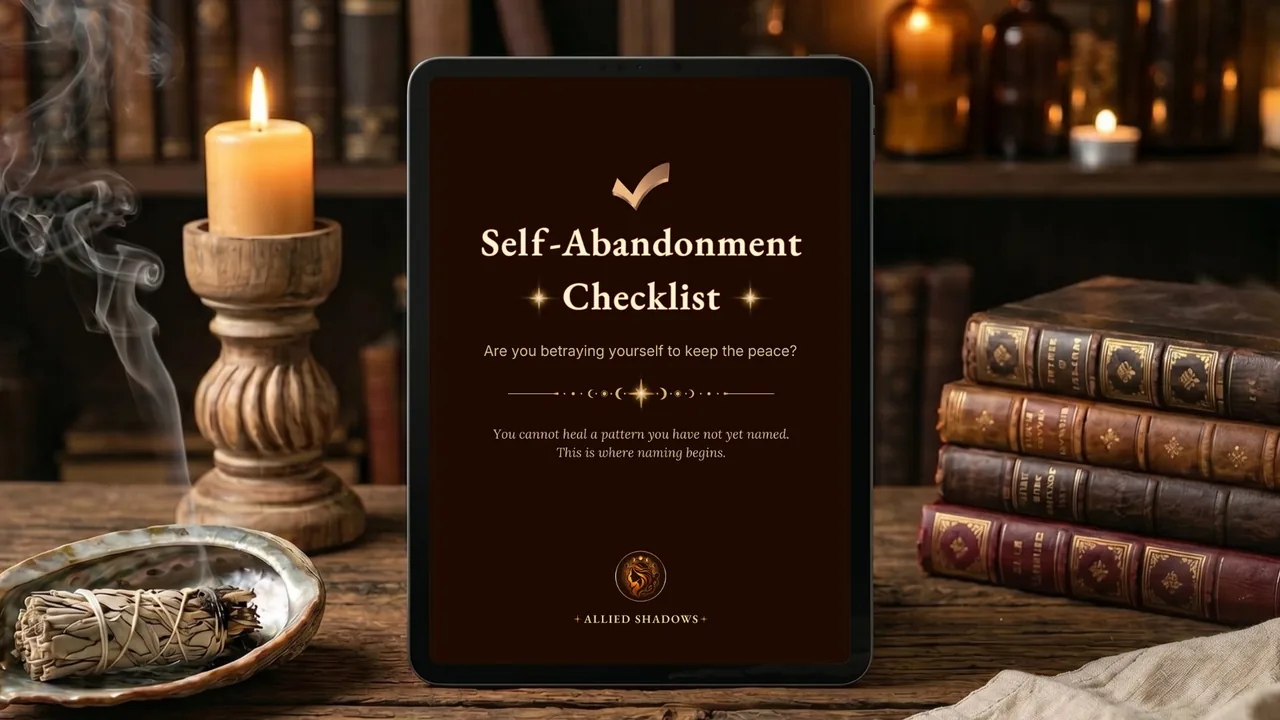
The Self-Abandonment Checklist — guide cover displayed on a tablet in a candlelit study with sage and old books
If You’re Reading This, You Already Know

That exhaustion you keep
calling burnout?

You say “I’m fine” when you’re not. You apologize for having an opinion. You rehearse conversations in your head so you don’t accidentally trigger someone else.

You say yes when every cell in your body is screaming no — and then you wonder why you’re so tired all the time.

That exhaustion is not burnout. It’s the cost of performing a version of yourself that was never real — and you’ve been paying it for so long, you forgot there was another option.
What’s Inside the Checklist

20 Statements.
Three Layers Deep.

Self-abandonment is not a single dramatic act. It is a thousand small betrayals, repeated daily. The checklist names them across three layers — from what you feel, to what you do, to who you have quietly become.

01 Layer One

The Emotional Patterns

The feelings you suppress, minimize, and perform around — because they were never welcomed.

  • You say “I’m fine” when you are absolutely not fine.
  • You feel guilty for having needs — even basic ones.
  • You cry alone but perform composure in front of others.
02 Layer Two

The Behavioral Patterns

The ways self-abandonment shows up in what you do — in your reflexes, your apologies, your overrides.

  • You say yes when every cell in your body is screaming no.
  • You ignore your body’s signals because someone else needs you first.
  • You abandon your opinion the moment someone pushes back.
03 The Deepest Layer

The Identity Patterns

Where self-abandonment has eroded your sense of self — the parts that no longer feel like yours to claim.

  • You’ve lost track of what you actually want.
  • You define your worth by how useful you are to others.
  • You secretly believe that if people saw the real you, they would leave.
What Happens After You Check the Boxes

This is not a quiz.
It’s a mirror.

After the checklist, you’ll find a What This Means section that reframes every single item you checked — not as a flaw, but as something far more accurate.

What You’ve Been Calling It

Evidence of Weakness

Proof that you’re too sensitive. Too needy. Too much. The reason you can’t seem to hold a boundary, ask for help, or stop apologizing for taking up space.

What It Actually Is

Evidence of Adaptation

You learned to abandon yourself because, at some point, it was the safest option available to you. That strategy was intelligent. It kept you protected. But the cost is you.

An Honest Filter

Is This Checklist
For You?

+This is for you if…

  • You’re the woman everyone leans on — and no one thinks to check on
  • You feel guilty for having boundaries and terrified of what happens when you set them
  • You’ve lost track of your own preferences because you’ve spent years deferring to everyone else’s
  • You freeze when someone asks “What do you want?” — because you were never taught your answer mattered
  • You perform “okay” so well that no one ever sees what’s underneath
  • You’re starting to realize your people-pleasing isn’t generosity — it’s survival

This isn’t for you if…

  • You want someone to tell you everything is fine
  • You’re looking for a personality quiz with a cute result at the end — this is a pattern excavation
  • You’re not ready to look at the ways you’ve been betraying yourself — no judgment. Come back when you are.
Why This Hits Different

You cannot heal a pattern
you have not yet named.

The items you want to skip past are the ones that need the most attention. That tightness in your chest when you read a statement and want to check the box but also want to look away — that’s the pattern trying to protect itself.

The fact that you’re here, willing to look — that is not a small thing. That is the first act of choosing yourself.
Before You Begin

Seeing the pattern is the
first act of reclamation.

Be honest. No one is watching. Check every statement that resonates.

Get Your Free Checklist

Instant download  ·  20 statements  ·  PDF

Making peace with the parts you hide.